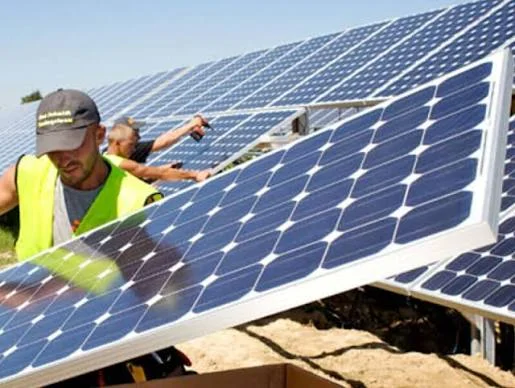
For most Irish homeowners the planning question has a short answer: rooftop solar on a house doesn’t need planning permission. The rules were relaxed in 2022 and the old limits on how much of a roof could be covered no longer apply to houses. But “no planning permission” is not the same as “no permissions at all” — and a few homes are exceptions. This guide helps you check both in a couple of minutes.
Check your home in four questions
| Question | If yes | If no |
|---|---|---|
| Is it a house (not an apartment)? | Continue | Apartments: see below — management company consent and a building-specific check |
| Is it a protected structure, or in an Architectural Conservation Area? | Contact the local planning authority before installing | Continue |
| Are the panels going on the roof? | Generally exempt, subject to conditions | Ground-mounted panels have a separate, smaller exemption |
| Is the home close to an airport, aerodrome or hospital helipad? | Ask your installer to confirm the current position for that location | Exempt in the usual way |
You can look up whether your home is a protected structure in your council’s Record of Protected Structures, and whether it is in an Architectural Conservation Area in the county or city development plan.
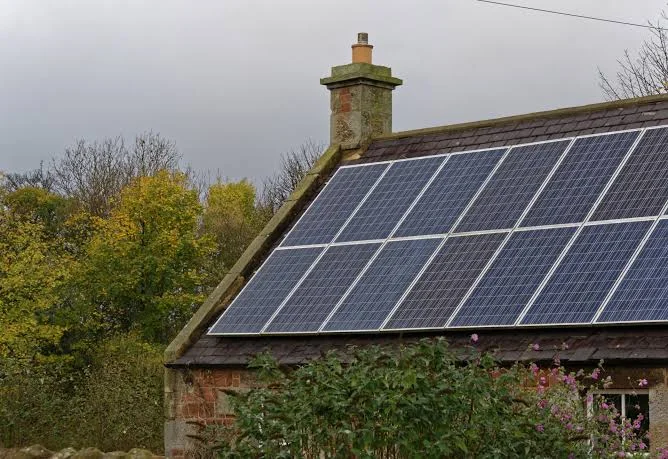
The conditions that come with the exemption
The exemption for rooftop solar on houses is conditional. The conditions cover practical design points, such as keeping panels a set distance from the roof edge and limiting how far they stand off the roof surface. A competent installer designs to these as standard — ask them to confirm in writing that the layout meets the current exemption conditions.
Ground-mounted panels in a garden are a different class of exemption with a maximum area and a requirement to keep enough private open space for the house. If your roof is unsuitable and you’re considering the garden, check the current conditions before you buy.
The permissions people forget
Planning is only one of several boxes. Before installation:
- ESB Networks notification. A grid-connected micro-generation system must be notified to ESB Networks. Installers normally handle this, but ask to see the confirmation — it’s also part of getting paid for exports. See selling electricity back to the grid.
- Your home insurer. Panels change the risk profile of a roof. Tell your insurer and check the panels are covered under buildings insurance.
- Management company or landlord. In apartments and in some estates, the roof or the façade is common property. You need written consent before work starts.
- Lease, title or estate covenants. Some properties have covenants about external alterations. A planning exemption does not override a private agreement.
- The SEAI grant conditions. If you’re claiming the grant, approval must come before installation. See the SEAI solar grant guide.
- Roof condition. No permission is needed to check it, but it’s the one most likely to cost money later. Ask the installer to assess the roof structure and any repairs before the panels go on — removing them later for a re-roof is expensive.
Common scenarios
- Semi-detached house in a suburban estate, roof in good condition. Exempt from planning; installer notifies ESB Networks; tell your insurer. If the estate has a management company, check its rules on external changes.
- Period house in an Architectural Conservation Area. Speak to the local authority’s planning or conservation officer first. Panels on a rear roof slope that isn’t visible from the street are often discussed differently from a front elevation, but the authority decides.
- Top-floor apartment wanting panels on the shared roof. Needs management company consent and a building-level solution; many blocks look at shared systems instead.
- Rural house with an unsuitable roof. Ground-mounted panels may be possible under the smaller exemption; check the area limit and open-space condition.
What to ask your installer
- Will the layout meet the current planning exemption conditions?
- Will you submit the ESB Networks notification, and will I get a copy?
- Have you checked the roof structure and condition?
- Is the system designed to the size I need? See how many solar panels do I need.