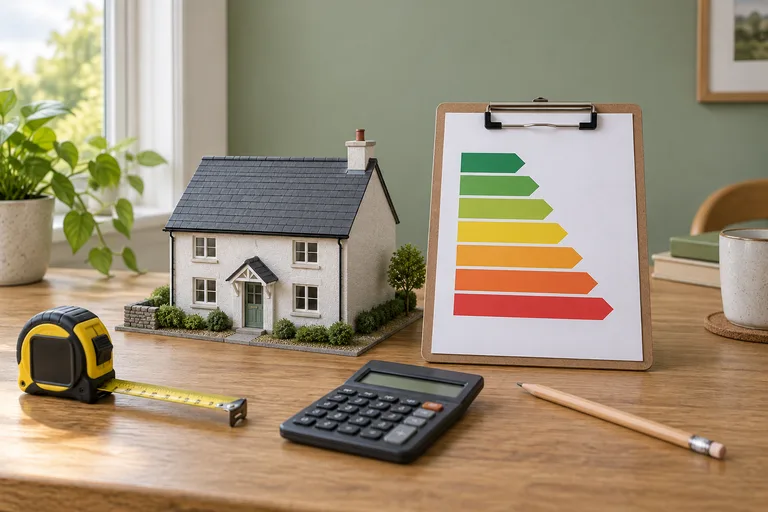
“BER: C” or “BER: C2” on a property listing tells you a lot once you know how the scale works — and where your own home sits tells you which upgrades will pay off. Ireland moved to a simplified scale in May 2026, so you’ll see both formats for years. This guide explains both, what a good rating is, how to read the certificate and advisory report, and the order of works that lifts a rating most.
The current scale: A0 to G (since 24 May 2026)
BER certificates issued from 24 May 2026 use eight bands without sub-bands. The rating still comes from the home’s calculated primary energy use per square metre per year — lower is better:
| New band | kWh/m²/year | Replaces on older certificates |
|---|---|---|
| A0 | ≤ 42, and must meet zero-emission criteria | New top band |
| A | ≤ 75 | A1, A2, A3 |
| B | 76–150 | B1, B2, B3 |
| C | 151–225 | C1, C2, C3 |
| D, E, F, G | Progressively higher energy use | D1 to G |
A0 is reserved for very efficient homes that also meet zero-emission requirements, including no fossil fuel use on site. The exact thresholds for D to G are set in the regulations; check SEAI’s BER pages for the current figures before relying on a specific number.
Older certificates: the A1–G scale
Certificates issued before 24 May 2026 stay valid for 10 years from their issue date, so you’ll keep seeing ratings like “C2” on listings. On that scale:
| Band | kWh/m²/year | What it usually means |
|---|---|---|
| A1 | ≤ 25 | Exceptionally efficient |
| A2 | 26–50 | New-build standard territory |
| A3 | 51–75 | Very efficient; deep retrofits can reach it |
| B1 | 76–100 | Efficient |
| B2 | 101–125 | Efficient; a common retrofit target |
| B3 | 126–150 | Good |
| C1 | 151–175 | Decent |
| C2 | 176–200 | Typical of partly upgraded homes |
| C3 | 201–225 | Fair |
| D1 | 226–260 | Common in older housing |
| D2 | 261–300 | Noticeable room to improve |
| E1 | 301–340 | Poor |
| E2 | 341–380 | Poor |
| F | 381–450 | Very poor |
| G | > 450 | Least efficient |
You can explore the older scale interactively on our home page. On either scale, the letter reflects the building — its fabric, heating system, windows, ventilation and any renewables — calculated for standard occupancy, not your household’s habits. The kWh figure on the certificate is the most precise way to compare an old certificate with a new one.
What counts as “good”?
- For a home you’re buying or renting: C or better suggests reasonable running costs; D or below tells you to budget for upgrades or higher bills.
- For your own home: a B is the sweet spot for most retrofits — a big reduction in energy use without the cost of pushing to A. A post-works B is also what the SEAI One Stop Shop route requires on the new scale (One Stop Shop vs individual grants).
- For a heat pump: what matters is the heat loss indicator recorded in the BER, not just the letter — see the heat pump grant guide.
How to read your certificate and advisory report
A BER comes with an advisory report that is more useful than the letter itself:
- The rating and the number — on the new scale the B and C bands each span 75 kWh/m²/year, so two homes with the same letter can differ a lot. The number shows how close you are to the next band, and lets you compare an older certificate with a new one.
- The heat loss indicator — the key figure for heat pump eligibility.
- The recommended measures — the assessor’s list of improvements for your specific home. Start there before spending money.
- Main heating system and fuel — useful for judging which grants apply, such as the heat pump renewable heat bonus.
How to improve your rating, in order
The sequence matters as much as the measures. Cutting heat loss first makes every later step cheaper and more effective:
| Order | Measure | Why it comes here |
|---|---|---|
| 1 | Draught-proofing and ventilation check | Low cost; stops uncontrolled heat loss without causing damp |
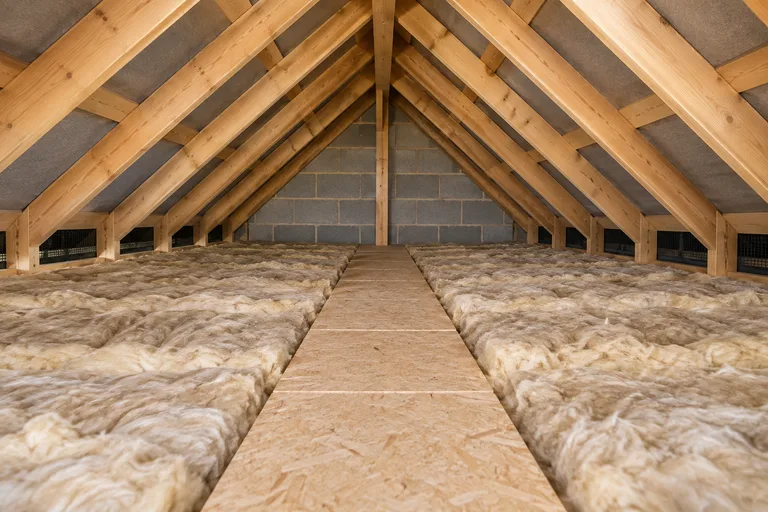
| 2 | Attic insulation | Usually the cheapest substantial improvement |
| 3 | Wall insulation | Large reduction in heat loss, especially in older homes |
| 4 | Heating controls | Zoning, timers and thermostats reduce wasted heat |
| 5 | Heat pump | Works best once heat loss is low |
| 6 | Solar PV | On-site generation improves the calculated rating |
| 7 | Windows and doors | Worthwhile when old and draughty; usually costly per band gained |
Most of these are part-funded by SEAI grants. Getting a BER before you start gives you a baseline and the advisory report; getting one after records the improvement.
A worked example of planning with your BER
Illustrative figures only. A semi-detached house has an older certificate showing D1 at 245 kWh/m²/year. Its advisory report flags a thin attic layer and uninsulated cavity walls, and the heat loss indicator is too high for a heat pump grant.
- Stage 1: attic and cavity wall insulation, both grant-aided. The heat loss falls, and the rating improves.
- Stage 2: with heat loss now lower, a technical assessment is done for a heat pump.
- Stage 3: heat pump and controls, then a post-works BER — issued on the new A0–G scale — to record the improvement.
The exact bands gained depend on the house, which is why the assessor’s report — not a generic list — should decide your plan.
Why your BER matters
- Selling and renting: a valid BER is required, and the rating must appear in the advertisement. See BER assessment cost.
- Running costs: a better rating usually means lower energy use for the same comfort.
- Grants: some grants and routes depend on the rating or heat loss indicator.