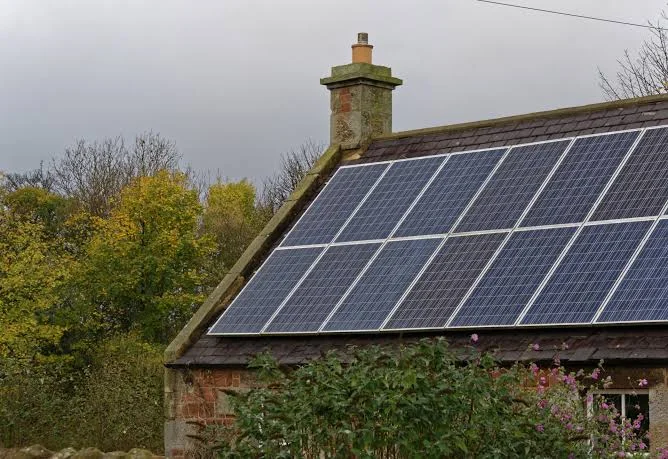
A battery stores daytime solar for the evening. That sounds like it should always pay, but in Ireland your surplus solar is already worth something: the Clean Export Guarantee pays you for exported units. So a battery doesn’t turn waste into savings — it turns cheap exported units into more valuable self-used ones. Whether that’s worth a few thousand euro comes down to a calculation you can do with your own rates.
What a battery costs
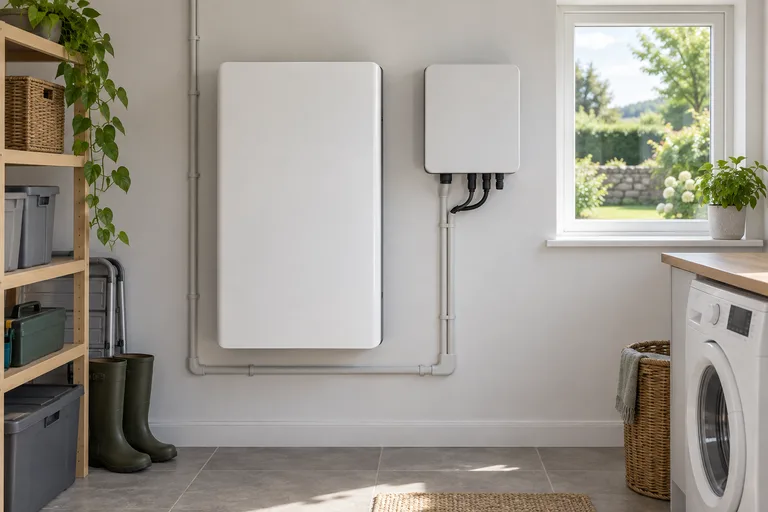
Adding a battery typically costs €3,000–€6,000 depending on usable capacity (kWh) and brand. These are indicative ranges — get quotes with and without a battery from the same installer so the difference is clear. The SEAI solar grant is calculated on panel capacity (kWp), so the battery is paid for without grant support. See solar panel cost in Ireland.
The formula
Annual battery value ≈ A × (import rate − export rate) + B × (day rate − night rate) − losses
- A — extra solar kWh per year the battery lets you use instead of export. It’s limited by the battery’s size, your evening use and the season: in winter there’s little surplus to store.
- B — kWh charged from the grid at a cheaper rate and used at a dearer one, if your tariff allows.
- Losses — some energy is lost in each charge and discharge.
A worked example
Hypothetical figures — replace them with your own:
| Assumption | Value |
|---|---|
| Battery | 5 kWh usable, extra cost €4,000 |
| Extra solar stored and used per year (A) | 1,200 kWh |
| Import rate / export rate | 30c / 15c |
| Winter cheap-rate charging (B) | 600 kWh at 18c, used instead of 35c day units |
| Losses | about 10% of energy cycled |
- Solar shifting: 1,200 × (€0.30 − €0.15) = €180
- Night-rate charging: 600 × (€0.35 − €0.18) = €102
- Less losses (≈10% of 1,800 kWh valued at about 30c): −€54
- Annual value ≈ €228, so simple payback ≈ €4,000 ÷ €228 ≈ 17–18 years
Two things change that picture quickly:
- A lower export rate. At a 5c export rate, solar shifting is worth 1,200 × €0.25 = €300 a year instead of €180.
- A bigger day–night gap, or a smart tariff with a very cheap window, increases the value of grid charging.
Compare the simple payback with the warranty period and the guaranteed capacity at the end of it: a battery that is unlikely to pay back within its warranty is a comfort or backup purchase, not a financial one.
Who benefits most
- Evening-heavy households, empty during the day, with a large summer surplus.
- Low export rate relative to the import rate.
- Night or smart tariffs, where cheap-rate charging adds value in winter — see is night-rate electricity worth it?
- Backup: some systems can keep essential circuits running in a power cut — check whether yours does, as many don’t by default.
Cheaper alternatives to try first
- Shift loads into daylight with timers on the dishwasher, washing machine and dryer.
- Charge an EV in daylight when possible.
- Divert surplus to hot water — often a cheaper way to use summer surplus; see export or hot water?
- Start without a battery and add one later if your bills show a large export volume — check the inverter is battery-ready.
What to ask before paying for a battery
- What usable capacity (kWh) is it, and what is the warranty period and end-of-warranty capacity?
- How much extra self-use do you expect it to create for my home, and how was that estimated?
- Can it charge from the grid on a cheap rate, and will you set that up?
- Does it provide backup during a power cut, and for which circuits?
- If I add it later instead, what would change in the installation?